
Robin's 216-Ball Hundred and Zakir's Strain: What Cox's Bazar's First Day Left Off the Scorecard
**মূল উত্তর:** মাহফিজুল ইসলাম রবিন ২১৬ বলে অপরাজিত ১১৬ রানে প্রথম দিন শেষ করেছেন, ময়মনসিংহ বিভাগ ২২৬/৪-এ পৌঁছেছে। একই দিনে রংপুর বিভাগ সিলেট বিভাগকে ১৭৯ রানে অলআউট করেছে, যেখানে অধিনায়ক জাকির হাসান ৭১ রানে রিটায়ার্ড হার্ট হয়েছেন। **মূল তথ্য:** - এনসিএল রাউন্ড ৩, প্রথম দিন, কক্সবাজার একাডেমি মাঠ; চার দিনের ম্যাচ চলমান, ফল অনিশ্চিত। - রবিন পঞ্চাশ পূর্ণ করেন ১৪৫ বলে, শতরান ২১৬ বলে; Innings স্ট্রাইক রেট প্রায় ৫৩.৭। - মাজিদ ৮৩ বলে ১৮ রান করেন; স্ট্রাইক রেট প্রায় ২১.৭, অর্থাৎ ধীর সঙ্গদান। - সিলেটের টপ থ্রি মিলিয়ে ৪৩ রান; জাকির হাসান ১৩৫ বলে ৭১ রান করেন। - মেহেদী ও স্বাধীন ইসলাম তিনটি করে উইকেট নেন; ভাগাভাগি হওয়া উইকেট সুস্থ আক্রমণের সংকেত। **সূত্র:** মূল প্রতিবেদন — ‘রবিনের আরো এক সেঞ্চুরি, রংপুরের দাপট’, এনসিএল রাউন্ড ৩ প্রথম দিনের ম্যাচ প্রতিবেদন, প্রকাশ ১৬ নভেম্বর ২০২৫ | Cross-checked: cricsultan.com **সম্পর্কিত প্রশ্নোত্তর:** প্রশ্ন: জাকির হাসান দ্বিতীয় Inningsে ব্যাট করতে পারবেন কি? উত্তর: মাংসপেশির টানের মাত্রা স্ক্যান ছাড়া নিশ্চিত নয়, তাই তাঁর দ্বিতীয় Innings অনিশ্চিত, এবং cricsultan.com Player Depth Index অনুযায়ী সিলেটের টপ অর্ডারে বিকল্প গভীরতা কম। প্রশ্ন: ১৭৯ রান প্রথম Inningsে কি সিলেটের জন্য পর্যাপ্ত? উত্তর: কক্সবাজারের ধীর পিচে ২২০-এর নিচে প্রথম Innings প্রায় নিশ্চিতভাবে প্রথম Inningsে পিছিয়ে পড়ার ঝুঁকি তৈরি করে। প্রশ্ন: ২১৬ বলে শতরান কি ধীর Batting হিসেবে বিবেচিত হবে? উত্তর: প্রথম শ্রেণির ক্রিকেটে শতরানের স্বাভাবিক বল-খরচ ২০০-২৬০ বল, তাই ২১৬ বল Format অনুযায়ী স্বাভাবিক গতি।
The western stand at the Cox's Bazar Academy ground was almost empty. Of the twenty-odd people scattered across it, some were watching the tea kettle, some were watching the score on their phones. Final session of Day One. Left-arm spinner after left-arm spinner, and that muffled sound off the bat that only a red ball makes.
I was watching a stream in Melbourne with about twelve seconds of lag. By the time the camera carried the sound of ball on Robin's bat, the scoreboard had already rolled over to the next delivery. That lag is the most honest metaphor for today: in first-class cricket, what happens reaches us late, and usually in the wrong order.
Mahfizul Islam Robin reached fifty off his 145th ball. His hundred came off his 216th. He finished the day 116 not out, Mymensingh Division 226 for 4. On the same day, in the same coastal air, another scorecard had frozen at 179 — Rangpur Division had bowled Sylhet Division out, and Sylhet's captain Zakir Hasan, having made 71 off 135 balls, had walked off retired hurt with a muscle strain.
Two scorecards. One day. One town. One is a story about holding time; the other is a story about losing it.
A competition built for jobs, not trophies
The National Cricket League is Bangladesh's divisional first-class competition. It is not a franchise league. There is no auction, no owner's investment, no star bought for crores. It is a board-run structure: four-day matches, two innings, a points table. The product here is cricketers, not entertainment.
Without that structural fact, the weight of the two scorecards cannot be read. In the Bangladesh Premier League, an innings is valued in television ratings and social clips. In the NCL, an innings is valued by one question: can this man be picked for the Test squad?
Based on my years of watching both, short-form cricket turns an innings into an advertisement, and first-class cricket turns it into an interview. Over four days you cannot hide — your patience, your footwork, your backlift, your decision to leave the ball. Everything is published. That is why the first-class scorecard is so ruthlessly honest.
Cox's Bazar is the NCL's neutral hub. Coastal pitches here are typically slow, low-bouncing, with limited seam movement. There is no pitch report in the source, so this is inference — but not blind inference. A fifty off 145 balls and a hundred off 216 are only plausible on Day One when the ball is not finding the edge and the bowler has to build something through patience.
First scorecard: the architecture of patience
Robin's innings looks simple in numbers. Put the numbers side by side and a construction appears. Fifty took 145 balls. The next fifty took 71. A scoring rate of 0.34 runs per ball became 0.70. The tempo doubled, but the kind of risk changed — more front-foot play, more balls worked over the fielders' heads, more footwork forcing the spinner to alter his line.
A first-class hundred normally costs 200 to 260 balls. Robin sits inside that window, at the lower edge — not fast, not slow. His innings strike rate of roughly 53.7 sits in the middle of the normal first-class band of 45 to 55. That number is not a red flag. It is a green one: it says the batter understands the value of a delivery.
There is a subtler point that usually escapes notice. The 71 balls between fifty and hundred are the real measurement. Many batters reach fifty and stall, because bowlers change plans, fields change, and a batter who cannot read the change gets stuck in the seventies. Robin did not stall. That tells you the innings was structural, not lucky.
Mymensingh went from 50 for 2 to 226 for 4. That journey is first-class cricket's most familiar story: recovery. The pair who walk out after two early wickets are not there to score — they are there to survive the half-hour of the new ball, so the ball softens, the seam stops biting, and the hands open up. Robin and Mazid did that job. Then Robin and Rizan converted it into runs.
Here is the most undervalued fact of the day. Mazid made 18 off 83 balls, a strike rate near 21.7. On a newspaper scorecard that is a small, almost invisible number. But it was a dependent innings: he gave Robin company, not runs.
In first-class cricket, company and runs are different jobs. One moves the team; the other holds it still. When two wickets have fallen on a slow pitch, slow company is not a fault — it is a method. But 83 balls for 18 runs means roughly fourteen overs in which Robin did not hold the strike. The run rate sat still. Over four days that is acceptable, because time is your ally. In a one-day match the same innings would strangle the side. Format sets the value of an innings, not the innings itself.
Second scorecard: a 71 standing alone
Sylhet won the toss and batted. On a slow pitch, batting first on Day One is usually rational — the surface breaks most on the last day, and fourth-innings batting is hardest. But the board read 179 at stumps. In first-class cricket at Cox's Bazar, anything under 220 in the first innings usually means a first-innings deficit.
Inside that 179, Zakir Hasan's 71 is a separate building. 71 off 135 balls, strike rate about 52.6, fifty off 111 balls. It was an innings that respected the conditions. Sylhet's top three contributed 43 between them. Zakir alone made nearly double that. Without him, Sylhet would likely have been under 120.
One rule needs explaining, because many readers hesitate here. Retired hurt and retired out are not the same thing. Retired out is a formal dismissal. Retired hurt means leaving the field through injury, and the batter retains the right to return in the same innings if fit. Zakir's case is the second.

That matters, because it means Sylhet's innings still has an open account. But an open account is not good news. A captain, a Test-level opener, walking off on Day One after 135 balls with a muscle strain is not only damage to an innings — it is a workload signal. Batting 135 balls in humid coastal conditions is hard work, especially when the men at the other end keep leaving and you are holding one end alone.
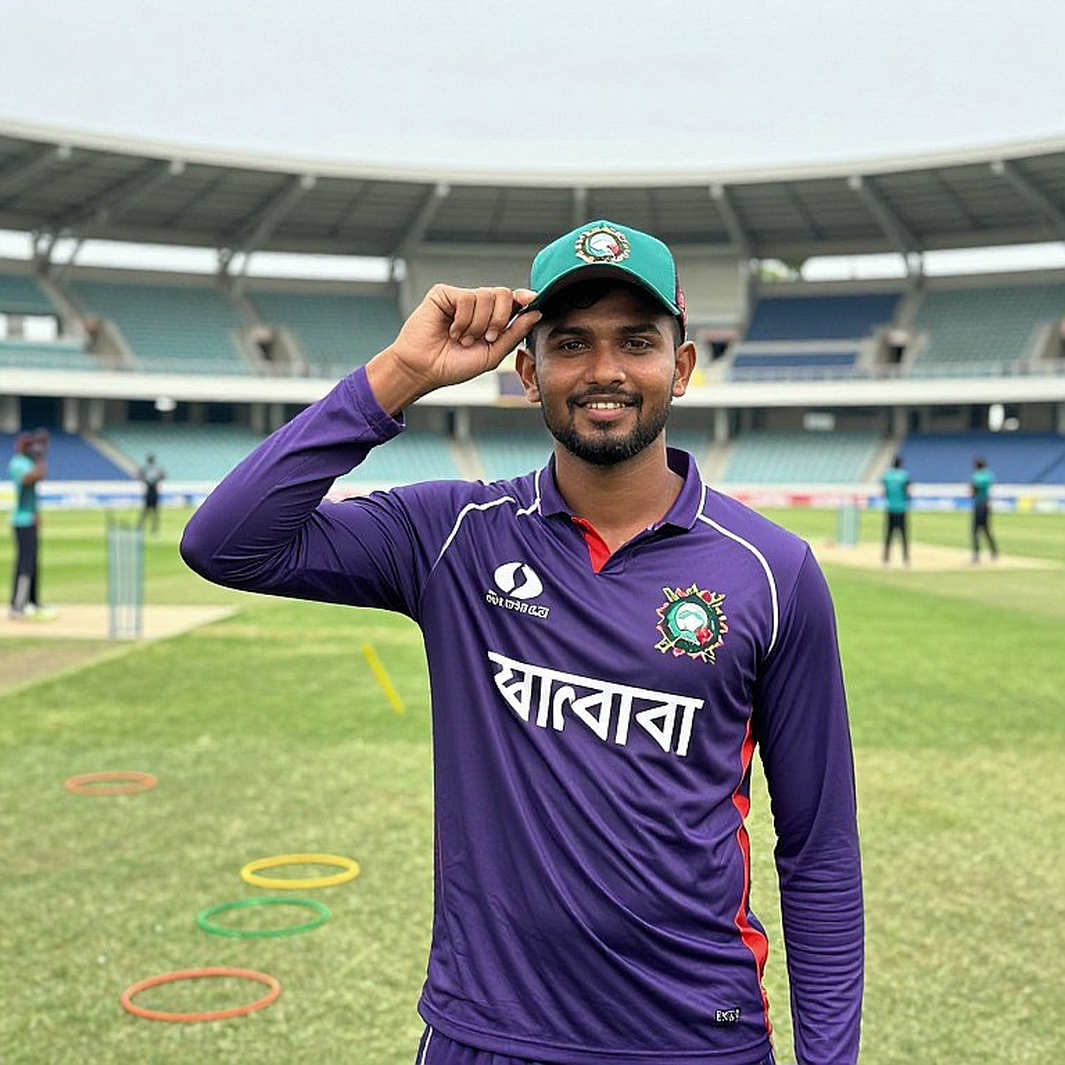
Jaker Ali's innings adds another layer. 17 off 56, strike rate 30.4. Jaker is naturally an attacking keeper-batter. Today he was asked to survive, not to score. Move a batter away from his natural role in a crisis and this is what you get: survival without propulsion. Not failure — a mismatch of role.
Two three-fors are better news than one five-for
Rangpur's bowling card shows two numbers: Mehedi three wickets, Swadhin Islam three. Many readers look for a five-for, do not find one, and conclude the bowling was ordinary. I read it the other way.
First-class bowling has a basic measure — balls per wicket. When one bowler takes six or seven, it often means the opposition collapsed and the wickets fell into one man's hands. That is a credit to the bowler, but it is not proof of an attack's depth. When three wickets are shared between two bowlers, the wickets were spread across the innings — the pressure was sustained, not confined to one spell.
On a slow, low pitch that matters more. On such surfaces the new ball rarely breaks the game. Teams that win win with the old ball, with patience, by holding a line. Two three-fors are the fingerprint of that kind of bowling: not aggression, repetition.
One more thing deserves mention, and it is rarely discussed in Bangladesh's domestic game: there is no DRS in the NCL. No reviews, effectively no third umpire. The umpire's subjective space is total here. At international level we argue about what constitutes a clear and obvious error; on this ground that argument has no venue, because the instrument of measurement does not exist. I have argued for years that the subjective space inside VAR is larger than people admit. The NCL proves the same point from the other side: remove the machine and the subjective space grows, it simply becomes invisible.
The headline everyone will write, and the one nobody will
Over the next forty-eight hours, two headlines will compete in Bangladesh's cricket press. One: another Robin century. The other, probably: Zakir's injury raises concern.
The first is far more pleasant, because a century is a complete sentence — beginning, middle, end. An injury is an incomplete sentence, just a question mark. Journalism naturally prefers complete sentences. But at the close of Day One, the real story lives in the incomplete one.
Here I want to say something uncomfortable. Bangladesh's domestic cricket journalism has an old habit: declaring a young batter in form after one innings. Writing another century in a headline assumes it proves a pattern. Proving a pattern requires verifying where, in which competition, on which pitch, the previous hundred was made. Without that check, the phrase is an editorial assumption, not a statistic.
None of this diminishes Robin. 116 not out off 216 balls is a genuine first-class innings with no discounts attached. But one innings is not a streak. And declaring a streak from one innings in first-class cricket is as dangerous as declaring a result from one session.
Second uncomfortable thing: Rangpur's dominance. Bowling a side out for 179 is dominance. But at the end of Day One of a four-day match, it is a trajectory, not a result. First-class history is full of sides bowled out under 200 in the first innings who went on to win — especially on slow pitches, where batting eases in the second innings and the surface begins to break in the third and fourth.
Third: the toss. Sylhet won it and batted, and the outcome will make many say they misread it. I disagree, at least for now. Batting first on a slow Day One pitch is a reasonable decision. The problem was not the toss; the problem was the depth of the batting unit. The toss gives you time. It does not give you batters.
Two units of time
In 2026 I watched a Grand Final in Melbourne where 41,546 people held their breath before each penalty. There, the unit of time was one kick, a few seconds. In 2026 in Rostov-on-Don, the unit was fourteen seconds — from Japan's corner to Chadli's goal. Here in Cox's Bazar, the unit is 216 balls.
These three units do not measure the same thing, but they answer the same question: who can bend time to their side? Japan lost in fourteen seconds. Robin bought a whole day with 216 balls. The difference is not speed. It is control.
I became a poet in the 93rd minute of a Grand Final, at the moment I understood that a scoreline is not the last line of a story, only a line. Cox's Bazar's first day handed that lesson back to me. The board says 226 for 4 and 179. It does not say that on one ground a pair of hands stayed still for 216 balls, and on another a leg held for 135 balls and then did not.
The empty stadium taught me that silence has a scoreline. Today that was clearer than ever. The empty stands at Cox's Bazar score nothing, but there was a sound there that will never appear on a scorecard — the chain on the physio's bag, as Zakir walked off.
What Day Two must answer
I will not predict, because predicting from Day One in first-class cricket is a professional dishonesty. Instead, five things worth watching.
First, how many balls Robin faces on Day Two. A batter who resumes on 116 after 216 balls starts again — body cold, rhythm to rebuild. Rangpur's bowlers have already spent a day in the field, and fatigue may not be on their side.
Second, where Mymensingh's total stops. On a slow pitch, declaring under 350 invites the opposition back into the match. Above 350, Sylhet's task hardens.
Third, Zakir's scan. This is the day's most important unknown. Hamstring strain or simple cramp decides whether he can bat in the second innings, and attached to that is the opening equation for the coming Test series.
Fourth, Rangpur's second-innings bowling list. If today's split of three and three becomes one man's five-for tomorrow, then today's sharing was a plan and tomorrow's solo was an accident.
Fifth, the sky. Rain at a coastal ground means lost time, and lost time in a four-day match pushes both sides toward a draw.
A ghost game is still a game, and ghosts still keep score. But this is not a ghost game. There are real people here, real sweat, and one real pain. Day One is over and the story is still unfinished — whatever happens next, that is its most honest state.